

Skateboard Setup Guide for New Riders: 2026 Basics
Table of Contents
- What Size Skateboard Is Best for Beginners?
- Skateboard Parts for Beginners: What Each Component Does
- Best Skateboard Wheels for Beginners: Diameter and Hardness
- How to Set Up a Skateboard: Step-by-Step Assembly
- Tuning Your Skateboard Setup: Truck Tightness and Wheel Bite
- Safety Checks and Maintenance for Your Skateboard Setup
- Conclusion
- Frequently Asked Questions
Last Updated: October 4, 2026
What Size Skateboard Is Best for Beginners?
The best skateboard size for beginners is usually a deck between 7.75 and 8.5 inches wide, paired with trucks that match the deck width. This range gives new riders enough stability to learn balance without making the board too heavy to control.
A skateboard setup is the combination of deck, trucks, wheels, bearings, and hardware that makes a complete board. Get the proportions wrong and the whole thing fights you.

Deck Width, Length, and Shape Explained
Deck width is the single most important number on your board. Measured across the deck at its widest point, it determines how much room your feet have to land and balance.
- 7.75 to 8.0 inches: Better for street skating and smaller riders
- 8.0 to 8.25 inches: The all-around sweet spot for most beginners
- 8.25 to 8.5 inches: More stable for transition skating and larger feet
Length and shape matter less at the start. Standard popsicle shapes dominate because they work for everything, so don't chase a specialty shape yet.
Matching Board Size to Age, Shoe Size, and Riding Style
Shoe size is a better guide than age. Men's size 8 or below fits 7.75 to 8.0 inches; size 9 to 10.5 fits 8.0 to 8.25; size 11 and up wants 8.25 to 8.5.
Riding style shifts the recommendation too. Some street skaters favor narrower decks for flip tricks. Many transition and park skaters want width for landing stability. If you're just learning to push and turn, err wider.
Skateboard Parts for Beginners: What Each Component Does
Every skateboard breaks down into six parts: deck, trucks, wheels, bearings, grip tape, and hardware. Understanding each one makes every later decision easier.

Trucks: Width, Height, and Turning
Trucks are the metal axles that connect your wheels to the deck, and truck width should match deck width as closely as possible.
Axle width is usually printed on the truck itself. For an 8.25-inch deck, look for a truck in the 8.25-inch range.
Bearings, Hardware, and Riser Pads
Bearings sit inside the wheels and determine how fast and smoothly you roll. Hardware is the eight mounting bolts holding your trucks to the deck. Riser pads sit between deck and truck to add clearance and reduce wheel bite.
For most beginners, a standard bearing set is plenty. You don't need to spend up on ceramics before you can ollie.
Best Skateboard Wheels for Beginners: Diameter and Hardness
The best skateboard wheels for beginners are usually 52 to 54 millimeters in diameter and 99A to 101A in hardness for park and street skating.

Wheel diameter controls roll speed and how well you get over cracks; hardness controls grip and slide.
A common mistake is buying hard, small wheels for rough Midwest streets. Match the wheel to the surface you actually ride.
Terrain |
Wheel Diameter |
Wheel Hardness |
Best For |
|---|---|---|---|
Smooth skatepark |
50-53mm |
99A-101A |
Street tricks, slides |
Rough pavement |
54-58mm |
87A-95A |
Commuting, cruising |
Mixed surfaces |
53-56mm |
95A-99A |
All-around riding |
Long distance push |
58-60mm |
78A-85A |
Smooth, fast rolling |
How to Set Up a Skateboard: Step-by-Step Assembly
Setting up a skateboard takes about 20 to 30 minutes with the right tools. Work on a clean, flat surface and lay out every part first.
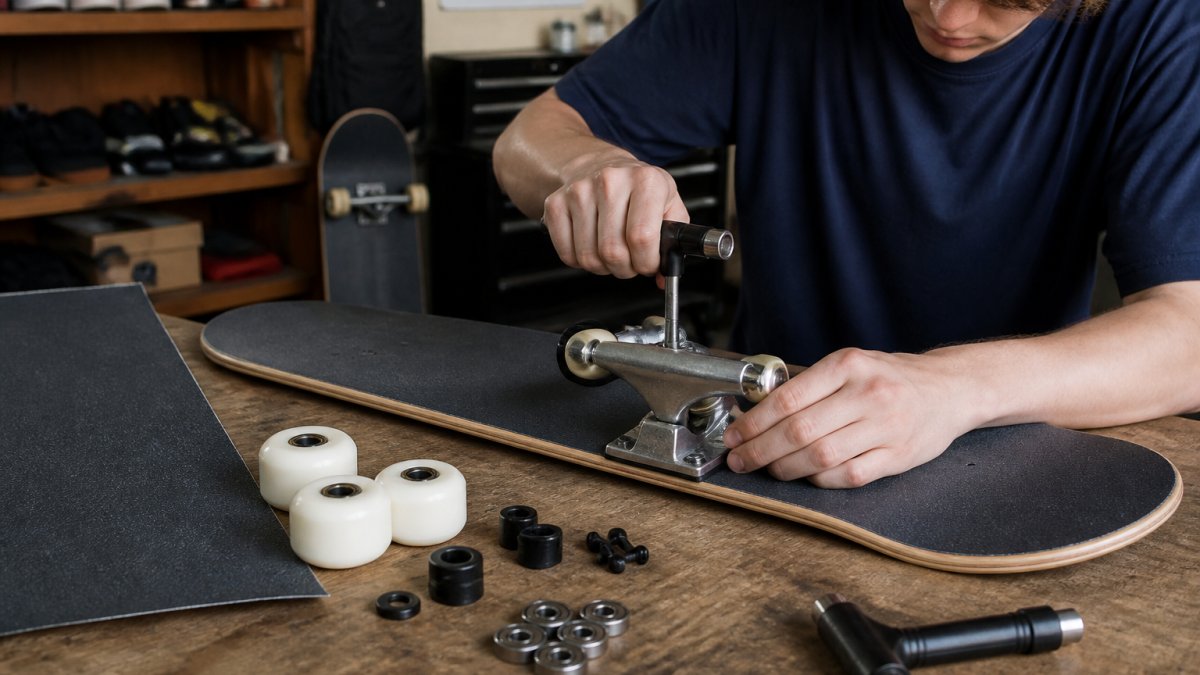
A skater using a skate tool to attach trucks to a new skateboard deck, with wheels, bearings, and grip tape.
Compatibility and Sizing Chart
Before assembling, confirm your parts match. Use this quick reference:
Deck Width |
Truck Axle Width |
Wheel Diameter |
Riser Pad |
Hardware Length |
|---|---|---|---|---|
7.75" |
7.6"-7.75" |
50-53mm |
None |
7/8-1" |
8.0" |
7.75"-8.0" |
50-54mm |
None |
7/8-1" |
8.25" |
8.0"-8.25" |
52-56mm |
1/8" if wheels over 54mm |
1-1 1/8" |
8.5" |
8.25"-8.5" |
53-58mm |
1/8"-1/4" |
1-1 1/4" |
A truck more than 0.25 inches narrower than the deck makes the board tippy, and a wider truck exposes the wheels to catching on landings. If you add a 1/4-inch riser, you need 1.25-inch bolts or the nuts won't fully thread.
Tools You'll Need Before You Start
You need a skate tool or 3/8-inch socket, a utility knife or scissors, a #2 Phillips screwdriver, and a bearing press or the truck axle itself. A skate tool covers the axle nut, kingpin nut, and mounting bolts in one piece. A bearing press is optional but prevents the most common cause of ruined bearings: pressing them in at an angle.
Step-by-Step Assembly
- Apply grip tape. Peel the backing, lay the tape over the deck, and press from the center outward with your palms. Work out air bubbles as you go. File along the edge of the board with a fairly flat angle and then trim the excess grip with a utility knife held at a 45-degree angle, pulling toward you.
- Poke the bolt holes. Push a screwdriver through the grip tape from the top side to expose all eight mounting holes. Run the screwdriver around the rim of each hole to clean the edge.
- Mount the trucks. Slide the bolts through from the top and thread the nuts on the underside by hand for the first two turns. This prevents cross-threading. Snug them, don't crank them yet.
- Seat the bearings. Press one bearing into each wheel until it seats flush. Drop the spacer in, then press the second bearing. If you're using the axle method, thread the axle nut on and tighten slowly until the bearing seats, then back it off.
- Attach the wheels. Slide each wheel onto the axle and tighten the axle nut until the wheel stops rattling but still spins freely. You want a tiny side-to-side play, about the thickness of a piece of paper.
- Final tighten. Go around all eight truck bolts and snug them down in a star pattern (top-left, bottom-right, top-right, bottom-left) so the deck seats evenly. Do the same for the second truck.
- Check the spin. Spin each wheel by hand. Any that stop early need a looser axle nut. Any that wobble side to side need a tighter one.
First-Ride Checks
After your first 10 minutes of riding, re-check all eight truck bolts and both kingpin nuts. New decks compress slightly under the hardware, and bolts that felt snug often loosen after the first session. Carry a skate tool for the first week.
New Career 8.5in Deck (Frankie Decker) →
Tuning Your Skateboard Setup: Truck Tightness and Wheel Bite
Truck tightness controls how much the board turns when you lean. Looser trucks turn sharply but feel unstable at speed. Tighter trucks feel stable but turn sluggishly. There's no correct setting, only the one that matches how you ride.
A Diagnostic Framework for Truck Tightness
Start with the kingpin nut flush with the end of the kingpin, then adjust a quarter turn at a time. Test by leaning side to side on carpet. You want the deck to tilt without the wheels touching. From there, use this decision guide:
Rider Weight |
Terrain |
Starting Tightness |
Adjustment |
|---|---|---|---|
Under 100 lbs |
Park or street |
Flush with kingpin |
Loosen 1/4 turn if turns feel stiff |
100-150 lbs |
Park or street |
Flush + 1/4 turn |
Tighten 1/4 turn for speed stability |
150-200 lbs |
Park or street |
Flush + 1/2 turn |
Tighten 1/4 turn if wheel bite appears |
Over 200 lbs |
Park or street |
Flush + 3/4 turn |
Add riser pad before tightening further |
Any weight |
Cruising or commuting |
Flush + 1/2 turn |
Loosen 1/4 turn for carving |
Heavier riders compress the bushings more under the same lean, so they need a tighter starting point. If you're between weights, start at the lower setting and tighten in quarter turns until the board feels predictable at your normal pushing speed.
Diagnosing and Fixing Wheel Bite
Wheel bite happens when the wheel contacts the deck during a hard turn, stopping the board instantly and usually sending the rider off. It shows as scuff marks on the underside of the deck above the wheels. Check by standing on the board and leaning hard to each side while a friend watches the gap.
Fix wheel bite in this order, from least to most disruptive:
- Tighten the trucks a quarter turn. This is the fastest fix and often enough for mild bite.
- Add a riser pad. A 1/8-inch riser adds clearance without changing your turning feel much. A 1/4-inch riser changes the feel more but solves persistent bite.
- Switch to a narrower wheel. A wheel that's 2mm narrower can eliminate bite without touching your trucks.
- Check your bushing condition. Worn or blown bushings let the hanger travel farther than it should. Replace them if they're cracked or squashed flat.
Bushing Hardness and Turning Feel
Stock bushings are usually 90A to 94A and work for most beginners. Under 120 lbs and the board won't turn? Try softer bushings (85A-88A). Over 200 lbs and it feels mushy? Harder bushings (95A-98A) firm up the turn without cranking the kingpin nut. Ride the stock ones for a few weeks before changing anything.
When to Re-Tune
Re-check truck tightness after the first week, after any wheel or bushing change, and any time the board feels different at speed. A board that suddenly turns sharper usually means a loose kingpin nut or a blown bushing, not a change in your riding.
Safety Checks and Maintenance for Your Skateboard Setup
A skateboard setup needs a quick inspection before every session and a deeper check every few weeks. Most board failures start as loose hardware that nobody noticed.
Pre-Ride Inspection Checklist
Run through this in under a minute before you ride:
- Spin each wheel and confirm it rolls freely
- Check all eight mounting bolts for looseness
- Confirm axle nuts aren't backed off
Replace bearings when they grind or seize, and swap wheels once they develop flat spots. Grip tape loses its grit over time; a fresh sheet restores control.
Conclusion
Building a first skateboard means juggling deck width, truck sizing, wheel hardness, and bearing quality, and getting one component wrong makes the whole board feel off. Cal Surf has outfitted Midwest riders since 1988, and our shop carries everything from Pepper G5 grip tape to complete deck-and-truck pairings.
Stop by, ask the basic questions, and we'll help you size it right the first time. Get started with Cal Surf and ride out on a setup built for how you actually skate.
Frequently Asked Questions
What parts do you need to set up a skateboard?
A complete skateboard setup needs seven parts: a deck, two trucks, four wheels, eight bearings, grip tape, mounting hardware (eight bolts), and riser pads if you want extra clearance. You'll also need a skate tool or a 3/8-inch wrench and a screwdriver. Buying these as a bundle usually saves money, but picking each part lets you match width, wheel hardness, and truck height to how you plan to ride.
What skateboard size is best for a beginner?
Most new riders do well on a deck between 7.75 and 8.25 inches wide. An 8.0-inch deck is the common starting point because it's stable enough for learning to push and turn, but still light enough to flip later. If you wear a men's shoe size 10 or larger, or you're over 150 pounds, lean toward 8.25. Smaller riders and kids often prefer 7.75. Width matters more than length for control, so start there.
How tight should skateboard trucks be for a beginner?
Start with the kingpin nut flush with the end of the kingpin, then tighten a quarter turn at a time until the trucks feel stable but still turn when you lean. New riders usually want them slightly tighter than experienced skaters because loose trucks wobble at speed. Test by standing on the board and leaning; if the deck touches a wheel, you're too loose. If you can't turn without lifting your heels, you're too tight.
What size skateboard wheels should a new rider get?
Beginners generally do best on wheels between 52mm and 54mm. This range rolls fast enough for street skating and smooth pavement without feeling sluggish, and it keeps the board low for easier pushing. If your local roads are rough, go up to 54mm or add a riser pad. If you plan to skate mostly at a park, 52mm keeps the board light and responsive. Pair the size with a hardness that matches your terrain.
Do beginners need soft or hard skateboard wheels?
It depends on where you ride. Hard wheels (99A to 101A) roll fast on smooth concrete and slide predictably, which suits skate parks and street spots. Soft wheels (78A to 87A) absorb cracks and pebbles, making rough pavement and commuting much smoother. Many new riders start with 99A because it's the middle ground for park and street. If your neighborhood streets are rough, a softer wheel will make learning far less frustrating.
How can you tell if a skateboard is set up correctly?
Do a quick pre-ride check: all eight mounting bolts should be snug with no gap between the truck baseplate and deck, wheels should spin freely for several seconds, and the kingpin nuts should be tightened evenly on both trucks. Push the board a few feet and listen for rattles. Stand on it and lean side to side; the trucks should turn smoothly without the wheels touching the deck. If anything rattles or sticks, tighten or loosen before you ride.
What safety gear should a new skateboarder wear?
At minimum, wear a certified helmet that fits snugly and sits level on your head. Wrist guards, elbow pads, and knee pads are strongly recommended while you're learning to fall, since most beginner injuries happen in the first few weeks. Closed-toe shoes with flat soles give you better board feel than running shoes. Check your gear before every session for cracks, stretched straps, or worn plastic, and replace anything that's damaged.
Should a beginner buy a complete skateboard or build a custom setup?
A complete skateboard is the fastest way to start because everything is already matched and assembled, and it usually costs less than buying parts separately. A custom setup makes sense if you already know your preferred deck width, wheel hardness, or truck brand, or if you want to upgrade one part at a time. Many riders start with a complete and then swap wheels or bearings as they learn what they like.