
How to Choose Snowboard Gear: 2026 Guide
Table of Contents
- Start With Your Riding Style, Not the Gear
- How to Choose Snowboard Boots First
- Snowboard Sizing Chart: Length, Width, and Your Anatomy (Generalized Chart)
- Snowboard Stiffness Ratings Explained
- Camber Profiles: Camber, Rocker, and Hybrid
- Binding Compatibility and Mounting Hardware
- Used vs. New Gear and Longevity
- Frequently Asked Questions
Last Updated: October 2, 2026
Start With Your Riding Style, Not the Gear
Learning how to choose snowboard gear starts with an honest look at how you actually ride, not a wish list of what looks good on the rack.
Riding style is the way you spend most of your time on the hill: cruising groomers, hitting park features, or chasing untouched terrain.
The most common mistake is buying a board first because it's the most exciting purchase.
All-Mountain, Freestyle, or Freeride?
All-mountain riding covers groomed runs, some park, and light powder, and it suits most riders who want one setup to do everything. Freestyle means park laps, boxes, and rails, which calls for a shorter, softer, more forgiving board. Freeride is steep terrain, trees, and deep snow, where stiffer, longer, directional boards hold up better at speed.
Be honest about which one describes your typical day. Most Midwest riders are all-mountain by default, since local hills favor groomers and park features over big mountain terrain.
The Order of Operations for Buying
Buy in this sequence and you avoid the expensive mistake of mismatched gear:
- Boots first, fitted to your actual foot
- Board length, width, and flex matched to your boots and weight
- Bindings sized to your boot and matched to the board's flex
- Outerwear and layers last, based on the conditions you ride
This order matters because a boot that's too large forces a wider board, and a binding that doesn't match your boot can leave you with heel lift no adjustment can fix.
How to Choose Snowboard Boots First
Boots are the single most important purchase, because they're the only piece of gear that touches your body directly. A boot that fits poorly ruins a day no matter how good the rest of your setup is.
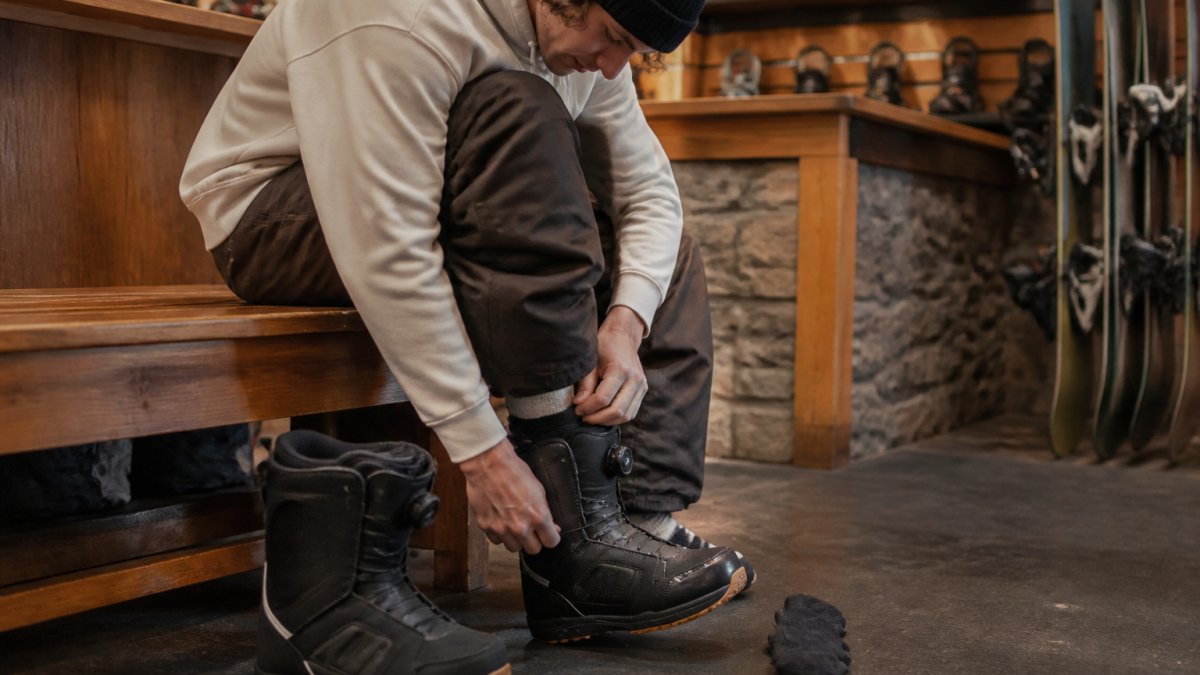
Heel lift is the amount your heel rises inside the boot when you flex forward. Any more than a small amount means the boot is too big or the wrong shape for your foot.
Boot Fit and Heel Lift
Measure your foot in the afternoon, when feet are slightly larger, and use a Brannock device or a wall-and-paper method. Your toes should lightly brush the front of the boot when standing, then pull back slightly when you flex into a riding stance.
Check heel lift by lacing up and pressing your shin forward. If your heel rises more than a centimeter, size down or try a different last.
Lacing Systems: Boa vs. Traditional
Boa lacing uses a dial and cables for fast, even tightening, and it's easy to adjust mid-run with gloves on. Traditional lacing offers more granular control and easier field repairs, but takes longer to dial in. Quick-pull systems split the difference with a single pull cord.
There's no wrong answer here. Boa suits riders who want speed and consistency; traditional laces suit riders who want to fine-tune pressure across the foot.
Snowboard Sizing Chart: Length, Width, and Your Anatomy (Generalized Chart)
A snowboard sizing chart matches board length to your weight and height, and board width to your boot size.
Rider Weight |
Board Length |
Boot Size (US Men's) |
Waist Width |
|---|---|---|---|
Under 120 lb |
138-145 cm |
Up to 8 |
240-248 mm |
120-150 lb |
145-152 cm |
8-9 |
248-254 mm |
150-180 lb |
152-158 cm |
9-10.5 |
250-258 mm |
180-210 lb |
158-162 cm |
10.5-12 |
258-264 mm |
Over 210 lb |
162-168 cm |
12+ |
264 mm+ |
Waist width is the narrowest point of the board, and it determines whether your boots overhang too far.
Your stance is the angle and width your feet sit at on the board. Goofy riders lead with the right foot, regular riders lead with the left.
Snowboard Stiffness Ratings Explained
Flex ratings run on a 1-to-10 scale, where 1 is soft and buttery and 10 is stiff and demanding. Most all-mountain boards sit between 4 and 7.
Torsional flex is how much the board twists along its length, which affects edge hold and turn initiation.
Match flex to your riding style and weight. Lighter riders often find stiffer boards hard to flex, while heavier riders can overpower a soft board and lose stability at speed.
Camber Profiles: Camber, Rocker, and Hybrid
Profile is the side-view shape of the board, and it decides how the board contacts snow, how it turns, and how it floats. It is the single biggest handling variable after length and width, so it is worth understanding before you buy.
The Three Families
Traditional camber arcs upward between the contact points, with the tip and tail touching snow and the middle lifted.
Rocker (also called reverse camber) curves the opposite way: the middle touches snow and the tip and tail lift. That lifted nose and tail float in powder and make the board feel loose and catch-free, which suits beginners and park riders.
Hybrid profiles combine the two. The most common variants are:
- Camber between the feet, rocker at the tip and tail: camber underfoot for edge hold, rocker up front for float. This is the most common all-mountain profile.
- Rocker between the feet, camber at the tip and tail: a looser, more playful feel underfoot with grip at the ends. Common on park and freestyle boards.
- Flat between the feet with rocker at the ends: a middle ground that is stable and predictable, often found on entry-level boards.
How to Pick
Match profile to the conditions you actually ride and to your experience level, not to what looks aggressive on the rack.
- Hardpack, ice, and groomers: traditional camber or a camber-dominant hybrid. Edge grip is the priority, and camber delivers it.
- Powder and trees: rocker or a rocker-dominant hybrid. Float and a catch-free nose matter more than edge bite.
- Park and freestyle: rocker-dominant or a rocker-between-the-feet hybrid. A looser feel helps with butters, presses, and switch riding.
- One-board quiver: a camber-between-the-feet hybrid is the safest all-around choice for most riders.
Weight matters too. A lighter rider may find a stiff, fully cambered board hard to flex and load, while a heavier rider can overpower a soft rocker board and lose stability at speed. If you are between two profiles, the more camber-dominant option is usually the better long-term choice for a rider who wants to progress on groomed terrain.
Binding Compatibility and Mounting Hardware
Bindings are the mechanical link between your boots and your board, so a mismatch here shows up as slop, heel lift, or a binding that simply will not mount. Work through three checks in order: boot-to-binding fit, binding-to-board mounting pattern, and binding-to-board flex match.
Boot-to-Binding Fit
Every binding is built around a boot sole length range, not just a US shoe size. A men's medium typically covers roughly 8 to 10.5, a large roughly 10.5 to 13, but those ranges shift by brand and by boot model.
If your boot overhangs the baseplate edge by more than a few millimeters, or the heel cup leaves a visible gap under the boot, size the binding up or down before you buy.
Mounting Patterns
There are three patterns you will encounter on current boards:
- 4x4 (4-hole): The traditional insert pattern, with eight inserts arranged in two rows of four. It offers fine stance-width adjustment in small increments.
- 2x4 (2-hole): Two inserts per side, common on many boards. Fewer stance-width positions than 4x4 but lighter and simpler.
- Channel: A single slotted track running down the board's center. Stance width and angle adjust continuously rather than in fixed steps, and it requires a binding with a channel-compatible disc.
Most bindings ship with a universal disc that fits 4x4 and 2x4, and many also include a separate channel disc or a disc that handles all three. Confirm which discs are in the box before you buy, because a binding without a channel disc will not mount to a channel board no matter how well it fits your boot.
Flex Match and Adjustment
Match the binding's flex to the board's flex and to your riding style. A stiff binding on a soft park board makes the board feel dead and unforgiving; a soft binding on a stiff freeride board leaves you with vague edge response at speed.
Once mounted, set your stance width and angles, then check that the highback sits roughly parallel to the board's edge and that the heel cup does not contact the board when you flex.
Used vs. New Gear and Longevity
Used gear stretches your budget, but inspect it carefully. Check boots for packed-out liners and cracked soles, boards for edge damage and delamination, and bindings for worn straps and cracked plastic.
New gear gives you a warranty and a known history, which matters most for boots and bindings, the parts that fail first.
Gear longevity comes down to care. Dry your gear after every session, store boards out of direct heat, and keep edges tuned.
Frequently Asked Questions
What size snowboard should I get if I'm 6'2"?
For a rider around 6'2", board length depends more on weight than height. A 160-165cm board fits most riders in the 160-190 lb range for all-mountain riding. If you weigh more, look at 158-162cm for freestyle or 162-168cm for freeride. Always check the snowboard sizing chart from the manufacturer, since effective edge, waist width, and sidecut change how a board feels underfoot.
How should snowboard boots fit?
Your toes should lightly brush the front of the boot when you stand with knees slightly bent. Heel lift should be zero when you flex forward. A proper boot fit is snug but not painful, and your toes should not curl. Try boots on with the socks you actually ride in. If a boot feels loose in the heel, size down or try a different model, because heel lift kills control on edge transitions.
Is camber or flat better for beginners?
Flat or rocker profiles are more forgiving for beginners because they catch edges less and make turn initiation easier. Traditional camber offers more pop and edge hold but demands cleaner technique. A hybrid profile, often called camber-rocker-camber, splits the difference. Many entry-level riders do well on a flat or hybrid board for their first two seasons, then move to full camber once their turns are consistent.
Is a 20 year old snowboard still good?
It can be, but check the base, edges, and core for damage. Older boards often have rusted edges, delaminated topsheets, or compressed cores that kill flex. Bindings from that era may not fit modern mounting hardware or meet current release standards. If the board has been stored dry and indoors, it may still ride fine for a beginner, but a used board from the last five years usually gives better performance for the money.
What safety gear is essential for snowboarding?
A helmet is the single most important piece. Wrist guards, impact shorts, and knee pads reduce common beginner injuries. Goggles with proper lens tint for flat light and waterproof gloves matter more in Midwest conditions than most riders expect. Layering with moisture-wicking base layers and a waterproof shell keeps you warm and dry, which reduces fatigue and improves reaction time on ice.
Do I need to match bindings to my snowboard brand?
No, but you do need to match the mounting pattern. Most modern boards use a 2x4 or 4x4 insert pattern, and most bindings include discs for both. Channel systems, like those on some Burton boards, require specific binding discs. Check your board's insert pattern and your binding's disc compatibility before buying. Baseplate size should match your boot size to avoid toe drag or heel drag.
Choosing snowboard gear comes down to matching each piece to your body and your riding style, and getting the sequence right so nothing fights the rest of your setup. Cal Surf has outfitted Midwest riders since 1988 with snowboards, boots, bindings, and apparel from top brands, and our print shop adds screenprinting, embroidery, and custom vinyl stickers when you want gear that looks like yours. Get started with Cal Surf and build a setup that fits from the boots up.