

Best Skateboard Decks for Beginners: 2026 Guide
Table of Contents
- What Makes a Good Skateboard Deck for Beginners
- Understanding Beginner Skateboard Deck Size
- Why the 8.25 Skateboard Deck Works for Beginners
- How to Choose a Skateboard Deck: Key Factors
- Complete Skateboard vs. Deck Only: What Beginners Need
- Top Beginner Skateboard Decks: Quick Comparison
- Frequently Asked Questions
Last Updated: October 7, 2026
What Makes a Good Skateboard Deck for Beginners
Finding the best skateboard decks for beginners comes down to three core factors: size, shape, and stability. A good beginner deck balances these elements to make learning easier, not harder.
The mistake most beginners make is picking a deck based on looks alone. You need a deck that actually supports how you'll learn. Too wide and you'll struggle with control. Too narrow and you'll lack the stability to build confidence. Too soft and it won't pop tricks.
This guide breaks down what separates a deck that works from one that doesn't, with specific recommendations from our inventory to get you started.
Understanding Beginner Skateboard Deck Size
Deck width and length are the two measurements that matter most, but the numbers only help if you can map them to your own body and riding plans. A complete skateboard deck for beginners typically ranges from 8.0 to 8.25 inches wide and 31 to 32 inches long.
Use the selector below as a starting point, then adjust based on feel. These pairings reflect the most common beginner profiles, not hard rules.
Rider Profile |
Shoe Size |
Height |
Recommended Width |
Wheelbase |
Best For |
|---|---|---|---|---|---|
Smaller teen or petite adult |
7-8 |
Under 5'4" |
7.75"-8.25" |
13.75"-14.0" |
Technical tricks, lighter control |
Average adult beginner |
8.5-10 |
5'4"-5'9" |
8.0"-8.50" |
14.0"-14.25" |
All-around street and park |
Taller or larger-foot rider |
10.5-12 |
5'9"-6'1" |
8.25"-8.5" |
14.25"-14.5" |
Stability, cruising, transition |
Big-and-tall rider |
12+ |
Over 6'1" |
8.5"-8.75" |
14.5"+ |
Maximum platform, bowl riding |
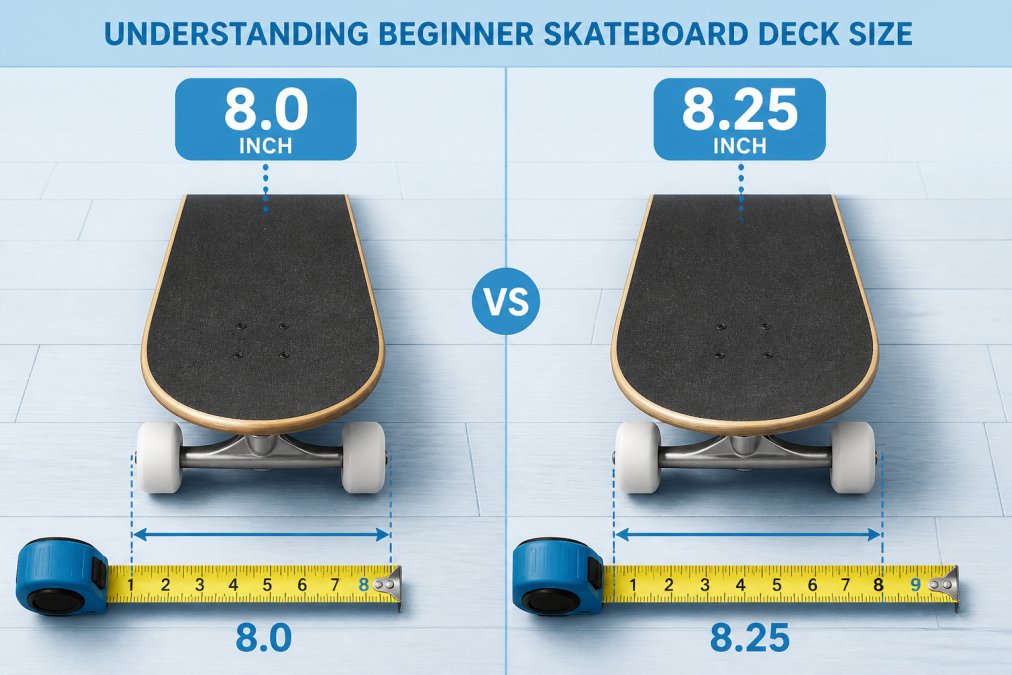
Two skateboard decks positioned side by side on a wooden floor showing visible width differences, with a measuring tape displaying 8.0 and 8.25 inch measurements clearly visible
How Deck Width Affects Stability and Control
Deck width determines how your feet sit on the board. A narrower deck (7.75 to 8.0 inches) feels more responsive and lighter, making it easier to flip and spin.
A wider deck (8.25 to 8.5 inches) gives you more surface area for your feet. This extra room makes balance easier when you're learning, especially if you wear larger shoes or prefer a more stable platform.
The wheelbase, the distance between your front and rear trucks, also affects how the board feels. A shorter wheelbase (around 14 inches) makes the board easier to maneuver. A longer wheelbase (14.5 inches or more) provides more stability at speed.
Deck Length and Wheelbase for Balance
Length matters less than width for beginners, but it still affects your overall experience. A 31-inch deck is considered short and suits riders under 5'6" or those who prioritize trick learning. A 32-inch deck is standard and works for most riders. Anything longer than 32 inches leans toward cruising rather than tricks.
The relationship between wheelbase and length determines how the board responds. A longer wheelbase relative to deck length creates a more stable, planted feel. This stability helps beginners practice their stance and weight distribution without the board feeling twitchy.
Matching Width to Terrain
Your intended terrain should nudge the width you pick. Street skating rewards a narrower deck (7.75 to 8.25 inches) because flip tricks rotate faster on less mass. Park and transition skating rewards a wider deck (8.25 to 8.5 inches) because the extra platform absorbs landings and holds your feet through ramps. Cruising and commuting sit in the middle, where an 8.25-inch deck balances push stability with enough agility to weave around obstacles.
If you're unsure where you'll end up, an 8.25-inch deck is the safest single choice because it works acceptably in every one of those settings.
Why the 8.25 Skateboard Deck Works for Beginners
An 8.25 skateboard deck for beginners has become the industry standard for good reason. It's wide enough to accommodate most shoe sizes and foot placements, yet narrow enough to remain responsive when you start learning tricks.
Most complete skateboard setups and beginner-focused decks come in 8.25 inches. This consistency means you'll find trucks, wheels, and hardware designed specifically for this width.
The 8.25 skateboard deck for beginners also feels natural when transitioning from learning basics to attempting tricks. You won't outgrow it quickly. Many skaters stick with 8.25 even after years of progression because it remains versatile for street skating, park sessions, and casual cruising.
How to Choose a Skateboard Deck: Key Factors
Start by matching deck size to your body. If you're under 5'6" and wear shoes size 8 or smaller, an 8.0-inch deck works. If you're 5'6" to 5'10" with shoe sizes 9-11, go with 8.25 inches.
Next, assess your intended riding style. This determines the deck shape and concave depth you'll need. Then check the construction quality. A beginner deck should use quality maple plies (the layers of wood that make up the deck) so it holds up through learning and occasional crashes.
Finally, consider your budget. Spending less often means lower-quality wood that won't pop properly or will break sooner. Spending more doesn't add value at the beginner stage.
Street Skating vs. Park Skating Decks
Street skating decks are designed for tricks, ledges, and technical maneuvers. They're typically narrower (7.75 to 8.25 inches) with a more pronounced concave. This shape locks your feet in place and makes flips and shuvits more predictable.
Park skating decks tend to be wider and looser, built for flowing transitions and vert tricks. They're less forgiving for technical street tricks.
Most beginners benefit from a street-focused deck because tricks are what draw people to skateboarding. You can always transition to a different style later. Starting with a versatile street deck gives you the foundation to explore whatever direction interests you.
Deck Shape and Concave for Trick Learning
Deck shape refers to the overall profile, popsicle, old school, or hybrid. A popsicle deck has a symmetrical shape with a tail and nose that look similar. This is the standard for street skating and tricks.
Concave is the curve across the width of the deck. A medium concave (the most common for beginners) provides enough lock-in to keep your feet planted without feeling restrictive.
For beginners learning tricks, a popsicle shape with medium concave is ideal. This combination gives you enough feedback to understand how your weight affects the board without overwhelming you with technical feel.
Complete Skateboard vs. Deck Only: What Beginners Need
A complete skateboard comes with a deck, trucks, wheels, bearings, and hardware all assembled. A deck-only purchase means you're buying just the board and adding components separately. For beginners, a complete skateboard is almost always the better choice, but the reason is more specific than convenience.
Buying a complete removes the guesswork. Everything is sized and matched to work together. You don't have to research truck sizes, wheel durometers, or bearing types. You can start riding immediately. The quality is usually consistent because manufacturers engineer completes as systems.
Here's what actually has to match if you build from a deck only:
- Truck width: Trucks come in axle widths measured in millimeters. A deck around 8.0 inches pairs with a 129-139 mm axle; an 8.25-inch deck pairs with a 139-144 mm axle; an 8.5-inch deck pairs with a 144-149 mm axle. A mismatched truck makes the board feel unstable or the wheels stick out awkwardly.
- Wheel diameter: Smaller wheels (50-53 mm) suit street tricks and smooth parks. Larger wheels (54-60 mm) roll faster and handle rougher pavement. Beginners on mixed surfaces usually do well around 53-54 mm.
- Wheel hardness: Measured on the durometer scale, softer wheels (around 78A-87A) grip and absorb bumps, while harder wheels (99A-101A) slide predictably on smooth park concrete. Beginners often prefer something in the middle.
- Bearings: Sometimes rated on the ABEC scale, though ABEC ratings describe precision tolerances, not speed. Standard skate bearings work fine for learning; you don't need to chase a higher ABEC number. Many skateboard bearings have moved away from the ABEC ratings scale as it does not measure performance under a weighted circumstance.
- Hardware: Deck bolts come in standard lengths, but confirm they're long enough for your riser setup if you use one.
However, if you already have trucks and wheels you like, buying a deck-only makes sense. Cal Surf stocks several beginner-focused decks that pair well with standard hardware. Just confirm your truck width matches your deck width before ordering.
When Deck-Only Is the Smarter Buy
Deck-only becomes the better path in three situations. First, you already own a complete and only the deck is worn out, decks wear faster than trucks or wheels, so replacing just the deck stretches your budget. Second, you want a specific width or graphic that isn't offered as a complete. Third, you're upgrading from a department-store board and want to reuse nothing, in which case you're effectively building a complete anyway and should compare total cost against a pre-built setup.
For everyone else, especially a first-time buyer with no spare parts, a complete is faster, cheaper, and less error-prone.
Top Beginner Skateboard Decks: Quick Comparison
Deck Name |
Width |
Length |
Wheelbase |
Price |
Best For |
|---|---|---|---|---|---|
8.25" |
32" |
14.25" |
$73.99 |
All-around beginners |
|
8.25" |
32" |
14.25" |
$73.99 |
Street tricks |
|
8.25" |
31.7" |
14" |
$73.99 |
Responsive tricks |
|
8.0" |
31.78" |
14.18" |
$67.99 |
Smaller riders |
|
8.0" |
31.85" |
14.25" |
$73.99 |
Narrow preference |
|
8.12" |
31.75" |
14" |
$67.99 |
Balanced feel |
The Up Yours! 8.25in Deck represents the most reliable choice for beginners. It's a proven shape that works across different skill levels and riding styles. The 8.25-inch width gives you room to learn without feeling unwieldy.


If you wear smaller shoes or prefer a more nimble feel, the Through the storm 8.0 at $67.99 is the budget-conscious option. It's narrower and shorter, which helps if you're under 5'6" or learning tricks on a tighter board.
For riders who want something between 8.0 and 8.25 inches, the Floaty Friend 8.12 inches at $67.99 splits the difference. The slightly shorter wheelbase (14 inches) makes it responsive for trick learning while the wider width provides stability.
Frequently Asked Questions
Is an 8.25-inch skateboard deck good for beginners?
Yes, an 8.25-inch deck is ideal for most beginner skaters. It provides a balanced platform that's wide enough for stability while remaining maneuverable for learning tricks. The 8.25 skateboard deck for beginners offers enough surface area to build confidence without being too wide to control. Most beginner-friendly decks fall in the 8.0 to 8.25-inch range, making this size a proven starting point for street and park skating alike.
What deck size should I choose based on my shoe size?
Match your deck width to your shoe size for proper foot placement and balance. Riders with shoe sizes 5-7 typically prefer 7.5 to 8-inch decks, while sizes 8-10 work well with 8.0 to 8.25-inch decks. Larger shoe sizes (11+) may benefit from 8.5-inch or wider boards. Proper sizing ensures your feet sit comfortably over the trucks, giving you control for tricks like kickflips and ollies without your toes or heels hanging off the edge.
Should I buy a complete skateboard or just a deck as a beginner?
A complete skateboard vs. deck only depends on your budget and experience. Complete skateboards come pre-assembled with trucks, wheels, and bearings, making them convenient for beginners who want to start riding immediately. However, buying a deck only gives you flexibility to choose each component. Most beginners benefit from a complete setup to avoid compatibility issues, though many eventually upgrade individual parts as they progress.
How often do beginner skaters need to replace their deck?
Deck durability varies based on riding frequency and style. A beginner skating 2-3 times per week typically gets 6-12 months from a quality maple deck before noticeable wear affects performance. Frequent riders learning tricks may see faster wear due to pressure on the tail and nose. Inspect your deck regularly for cracks, splits, or soft spots. When the pop diminishes or the board feels unstable, it's time for a replacement.
Choosing your first skateboard deck shouldn't be complicated. Focus on size that matches your body, a shape built for tricks, and quality construction that lasts. Cal Surf carries beginner-focused decks that nail all three. Start with an 8.25-inch deck if you're average height, or adjust down to 8.0 inches if you're smaller. Pair it with decent trucks and wheels, and you'll have a setup that supports real learning instead of fighting against you.